
BUSINESS
TRANSFORMATION
Achieving extraordinary business ambitions under conditions of extreme uncertainty demands bold, and sometimes risky efforts. Drawing on over 20 years in the corporate arena, we specialize in people & culture-driven organizational and operational business transformation.
We reject generic, 'cookie-cutter' processes and theories. Instead, we use real-world learnings and battle-tested frameworks derived from both successful and unsuccessful corporate transformations. This approach allows us to accelerate your transformation, increase your likelihood of success, and achieve your extraordinary goals faster, more cost-effectively, and more sustainably.
Case Study 1
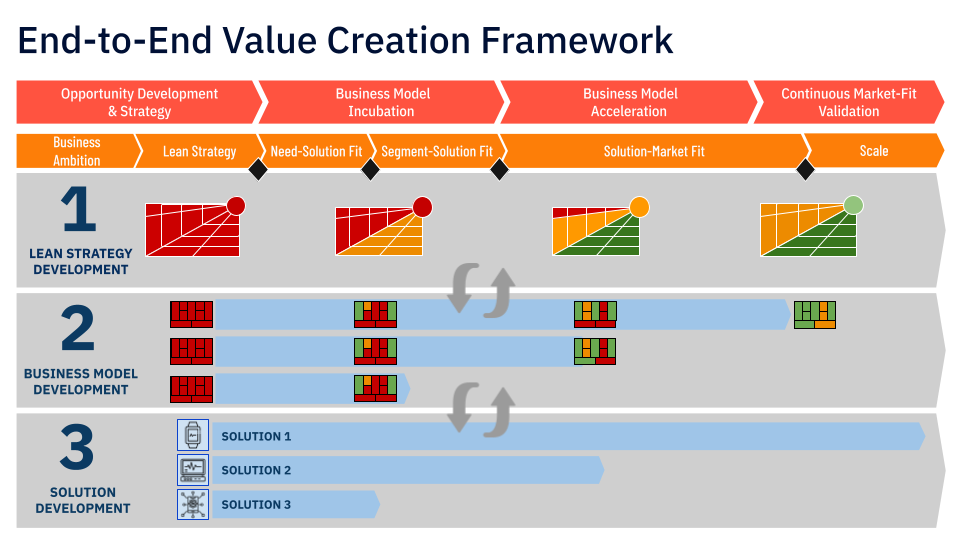
End-to-End Value Creation Transformation
The Challenge
When a multinational corporation evaluated its solution pipeline against defined growth ambitions, business leaders expressed low confidence in the pipeline’s ability to meet ambitious business objectives. Thus, we were tasked to support the organization in its effort to build a “fit for purpose innovation pipeline”. Due to the magnitude of of the challenges identified and the company’s urgency and importance to demonstrate “innovation progress”, it was clear that a company wide transformational effort was needed.
THE SOLUTION
We approached the challenge in several steps:
Diagnosing the problem: In a first step we diagnosed the problem to understand the deeper why behind the failed pipeline. We conducted bottom-up problem discovery interviews across multiple organizations to identify operational, behavioral and cultural barriers that prevented the organization from achieving desired progress toward ambitious business objectives. A key insight was that the organization had excellent vertical competencies but poor end-to-end value creation capabilities. Thus, our top priority objective shifted to the development of end-to-end value creation capabilities.
Design & testing of new end-to-end Value Creation Framework (VCF) V1.0: We co-designed & piloted a 1st generation end-to-end value creation framework and established “value creation / innovation ownership” across key functions (vs. building an innovation center of excellence).
Design & implementation of validated, improved VCF 2.0: Learnings from VCF 1.0 were used to inform the design and implementation of the 2nd generation VCF. One key objective was to apply the “right framework, with the right methods in the right environment with the right people at the right time" and continue demonstrating measurable progress towards strategic value creation objectives.
The Result
End-to-End value creation capability: innovation process/framework combined with a “fit for purpose” collaboration and governance model received full buy-in from business leaders and their organizations due to the co-creation design approach and the organization’s ability to demonstrate significant, evidence based progress, compared to previous processes and approaches.
Increased decision making confidence: business leaders expressed significantly higher confidence in their ability to make customer opportunity driven, evidence based investment decisions; especially under high pressure and under conditions of high uncertainty.
A MedTech company struggled with its ability to demonstrate commercial readiness of new solutions. The underlying challenges and root causes were complex in nature and we were not able to surface the “one key problem”. However, based on the market and business environment and the company’s operating model, culture and expertise, we concluded that the assumption of implementing a hybrid innovation approach was the most attractive for stress-testing - and thus inform a more evidence based decision on implementing a “fit for purpose, outcome driven” innovation model.
The Solution
After developing several hypotheses for how to minimize the time and effort to prove commercial readiness, we designed and tested a hybrid innovation model that allowed the company to fill the pipeline “organically”, using corporate venture teams, and with externally developed business models from startups. We then stress-tested 3 business model driven innovation approaches:
Business Model Incubator: A 4 week, timeboxed initiative where cross-functional teams were coached and mentored to design business models. Job-to-be-done based opportunity segments informed the design and prioritization of initial business models and solutions.
Business Model Accelerator: A 12 week, cohort based, structured program, similar to a venture building approach, that allowed the organization to accelerate the design, stress-testing and validation of business models.
Startup Accelerator: A “just-in-time” based, open innovation approach, that allowed to company to shorten “time to commercial-pilot readiness” using startups.
The Result
Company wide buy-in on approach and funding: just-in-time, metered funding and resource commitment across key organizations such as product management, marketing, R&D, commercial, portfolio management as well as business unit leaders.
Over 100 startups evaluated, 2 startup cohorts with 10 startups completed, resulting in 2 commercial pilots in record time completed.
Accelerator program achieved highest employee engagement scores while achieving mission critical funding milestones by demonstrating evidence based progress toward commercial readiness
Countless initiatives stopped due to lack of evidence of proving customer value and business value.
Case Study 2
Corporate Incubator & Hybrid Accelerator
The Challenge
What Customer Say
“As a coach, Marco challenged us (IVD startup) to quickly evaluate the business model strategy by using a structured approach with non-leading questions. We benefitted from his experience by pointing us towards topics we did not think about yet. In the end we got non-obvious, tactical recommendations for guiding our product and value proposition towards the different stakeholders. His startup coaching approach is extremely productive and we can highly recommend him as a coach & mentor.”
Jakub Slawinski, Startup Co-Founder
Max-Planck Institute
“The team gave us 3 building blocks that allowed us to build one of the most robust, evidence based business model pipelines in record time: the customer insights portfolio, a lean strategy approach and a hybrid accelerator program driven by internal venture teams and startups”
Joao Rodriguez
International Business Leader